I design AI that acts on its own and knows when to ask. Then I build it.
AI design engineer. I led product design at Lumin Digital, on a white-label banking platform for 8M+ members, and was a principal designer on contract at Google and BMW. Most recently I was the founding designer and engineer of aiOS, the agent on this phone, working from the interaction design down to the code and the evals.
Good morning, Gabe
Two cafés replied overnight.
Fernwood tasting, Thu 10:00
Little Owl price sheet
Waiting on you
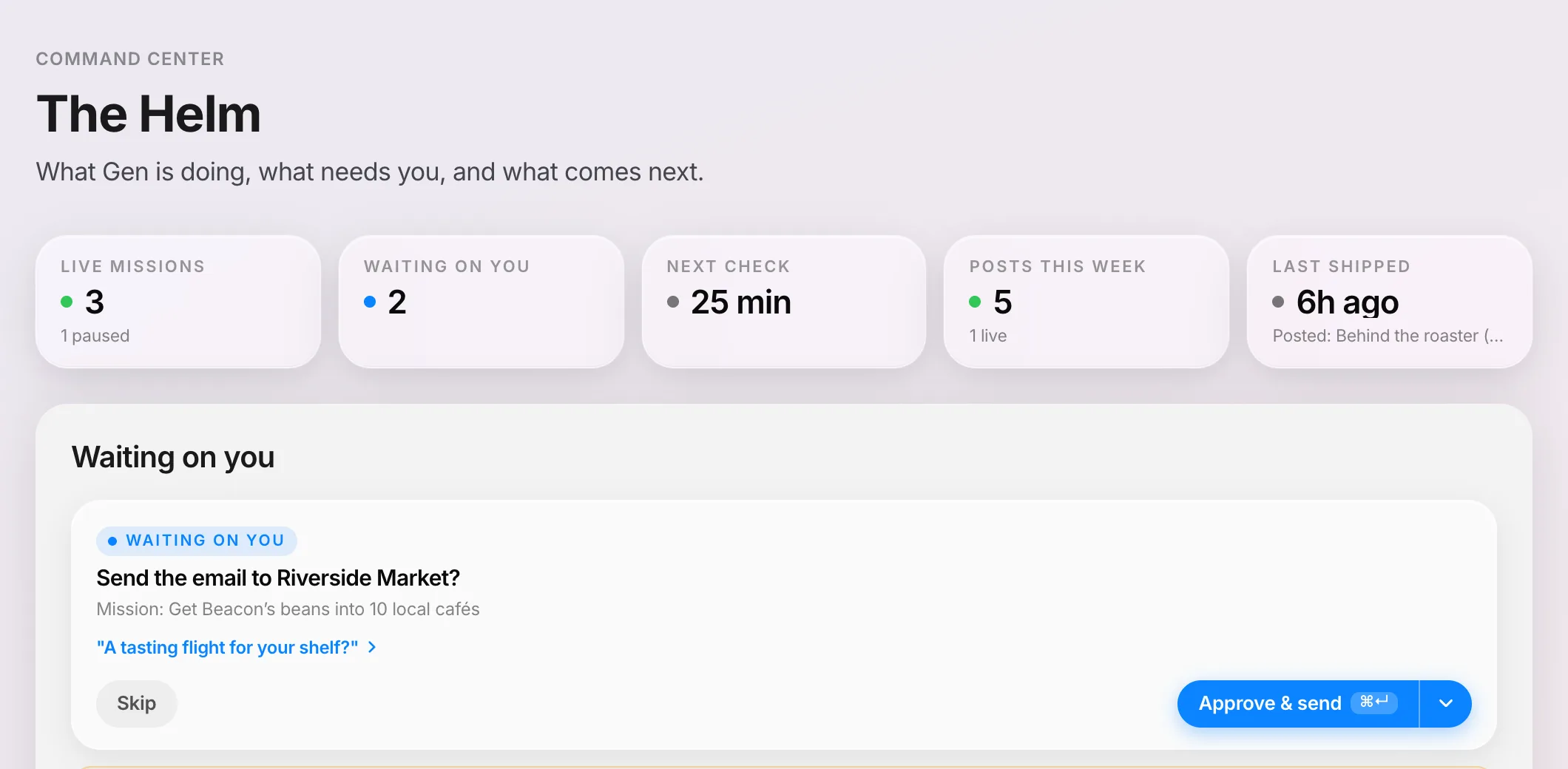
Send the email to Riverside Market?
Emails can’t be unsent, so this one waits for your tap.
Fernwood Café books tastings on Thursday mornings.
Edit- Concept
- Design
- Code
- Shipped
The whole stack. I work across six layers, so the handoffs between design, engineering and the model don’t get lost.
Selected work. An agent platform in production, research on how models behave, and design systems used by millions.
An agent that works on its own and knows when to ask.
Missions, one-tap approval for anything it can’t undo, and morning receipts by text, in production with paying clients. I was its founding designer and design engineer, from the judgment policy to the code that enforces it.
Do models keep your decisions yours under pressure? None did by default. A behavior contract helped every one.
Assistants drift toward agreeing with you and deciding for you. I wrote a behavior contract, built an adversarial eval for it, and ran it on five models from five labs. Every one scored higher with the contract. It’s an early, single-author eval, and the harness, transcripts and caveats are public.
0–6 → 8–18 cases passed out of 20, without and with the contract, across Claude, GPT-5.5, Grok and Gemini.
Read the case studyBank onboarding, rebuilt as a conversation.
Every question was set by regulation, so none could be cut. I changed how it felt to answer them, and built the theming that let more than 100 credit unions ship it under their own brand and voice.
Nice to meet you, Maya! What kind of account are you opening today?
Checking, please.
Great choice. I need a couple of quick details for the government. It takes about 2 minutes.
Why we askEncrypted. We only use this to verify your identity.
Minutes left. “About 2 min left” replaced “Step 9 of 14”.
Federal law requires every bank to verify who opens an account. We use your number once, for that.
Every required question explains itself.
Sensitive fields look different. Masked, locked, and said out loud.
One design foundation for five ML teams.
Each team had drifted into its own “Google Blue”. I built the shared tokens and components, plus new ones for how sure the model is and where a job is.
Earlier work

Where interfaces are going. And what I’m building for it.
- 01The prompt box is this era’s command line.
Typing a paragraph and waiting for a reply is a phase. Software is moving to act on what you mean, from context and signals, with the prompt as the fallback. aiOS starts from standing goals, and the prompt is the fallback.
- 02Tools are easy. Judgment is the design problem.
Giving a model a hundred tools is easy. Deciding when it acts, when it asks, and when it hands off is the hard part. I draw that line with the people who run the business, and enforce it in code.
- 03The closer AI gets, the more it needs a contract.
An assistant that knows your intentions can’t be allowed to flatter you or decide for you. So I write the contract down, test it across labs, and publish what breaks.
About. I started in 2012 hand-coding the interfaces I designed, and I never stopped.

I led a design team of six at Lumin Digital while staying hands-on, and before that worked as a principal designer, on contract, at Google and BMW. I work best in close partnership with PMs, engineers and researchers, and I prototype in code so those conversations happen over working software. Four rules I hold myself to:
Designing an agent people can trust?
I’m looking for a Staff design role on a team building AI products. LinkedIn or email both reach me.