aiOS — the AI employee that runs your business
I founded AI Genesis to answer one question: what does software look like when the interface is a relationship? aiOS is the answer — an agentic AI platform spanning iMessage, web, and voice, designed and coded end-to-end by me, live in production with enterprise deployments.
The walkthrough
Four chapters — RTR's AI employee, the solo build, onboarding cinema, and AI over iMessage.
The challenge
AI tooling in 2024 was powerful and unusable — prompt boxes, settings pages, workflow builders that assumed the user wanted to learn AI. Business owners don't. They want the work done.
The thesis: the text box is a fallback, not the front door. aiOS reads intent, surfaces what matters, and acts — iMessage as a first-class surface, onboarding as a conversation, every AI action visible enough to trust.
Shipped, not staged
Three production surfaces, one brain.
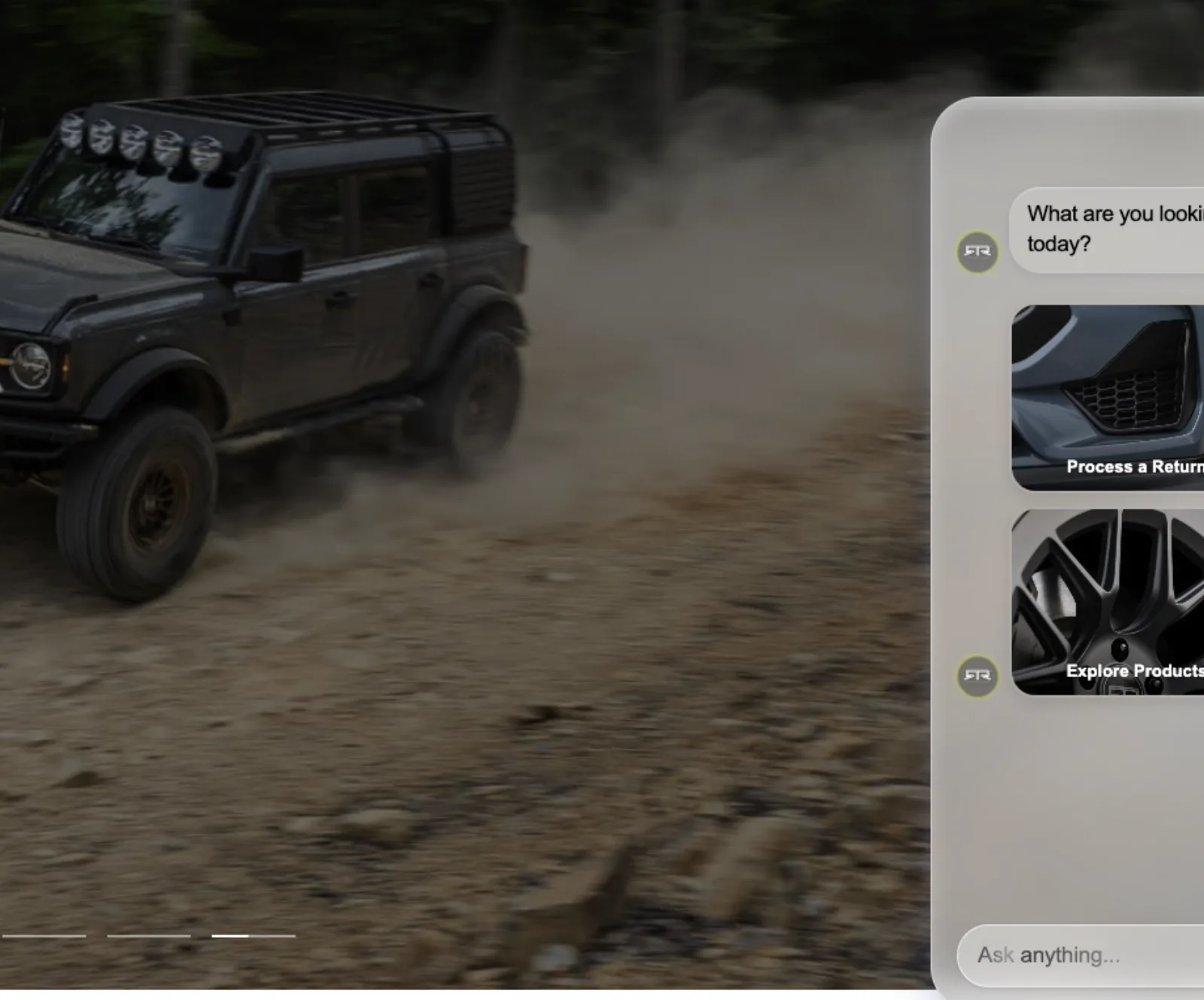
RTR Vehicles — embedded AI employee
A digital employee on rtrvehicles.com (bottom-right, live now): product discovery, fitment answers, order tracking, and smart escalation trained on the team's real support history. It replaced the workload of four full-time support hires — about $15K/month — while resolving 92% of conversations without a human.
Onboarding as cinema
Signup is a conversation. aiOS reads your website live on screen — scraping your palette, voice, and market position while you watch it think. It's less important what AI can do; it's more important how it makes people feel. Watching the system understand your business builds more trust than any feature list.
iMessage-native AI
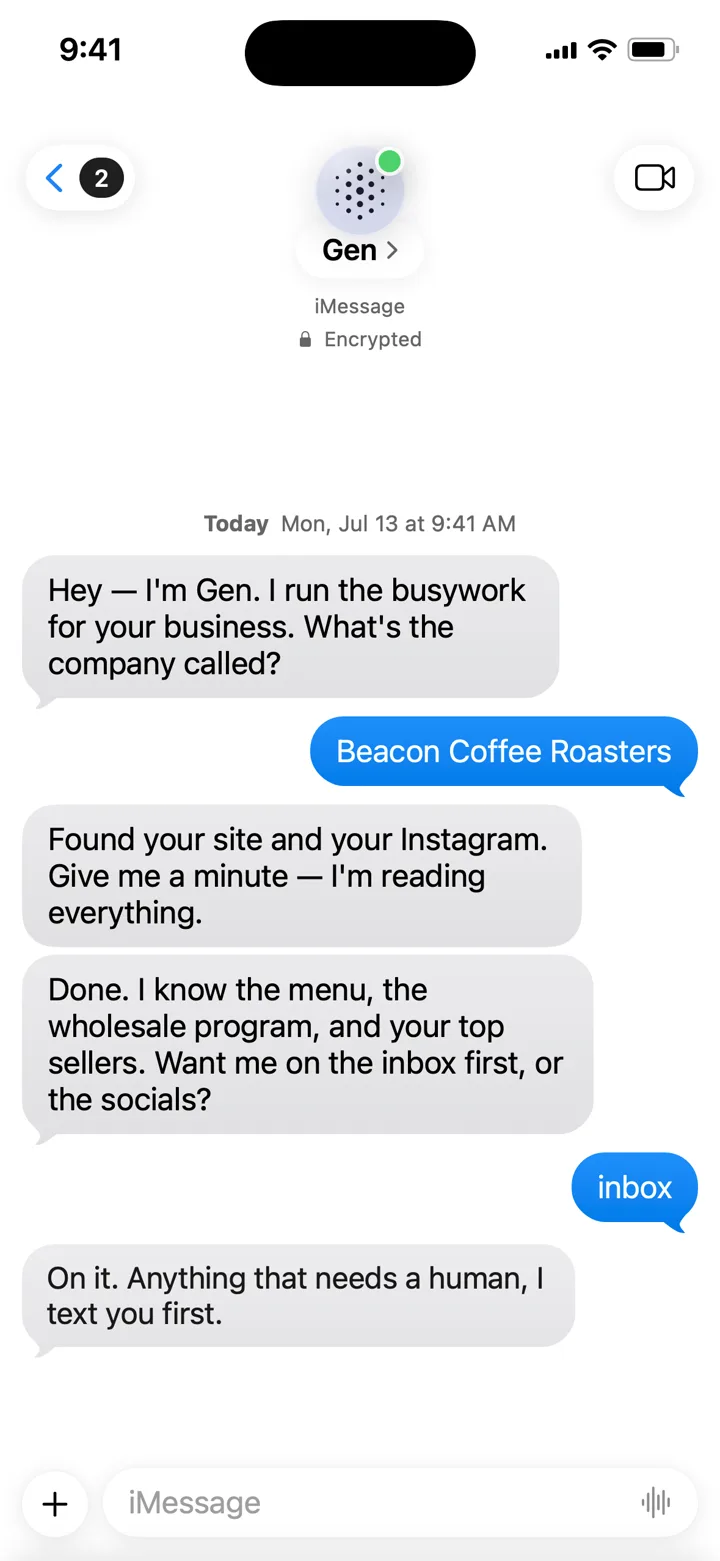
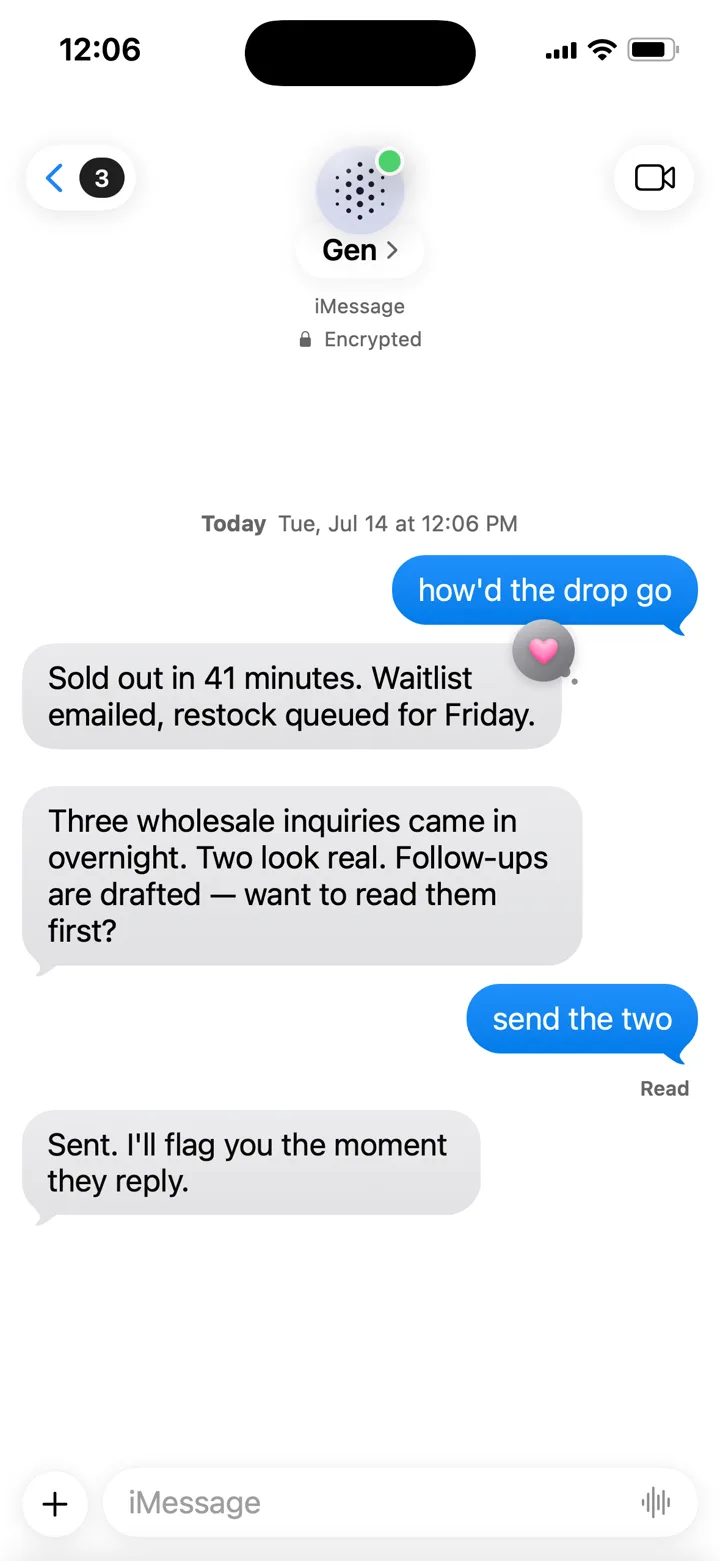
Gen — the aiOS commander — lives in your texts. Send a thought; get carousels, videos, websites, and campaigns back as finished deliverables. No app to open, no login, no prompt engineering. The most-used surface of the platform is the one users already had.
The actual conversations
Real iMessage threads, rendered with the production engine that powers live deployments — the same renderer, bubbles, and timing customers see.
Onboarding as a conversation
No intake form, no setup wizard — Gen introduces itself, reads the business, and takes its first task. Stills from the same production renderer as the clips above.
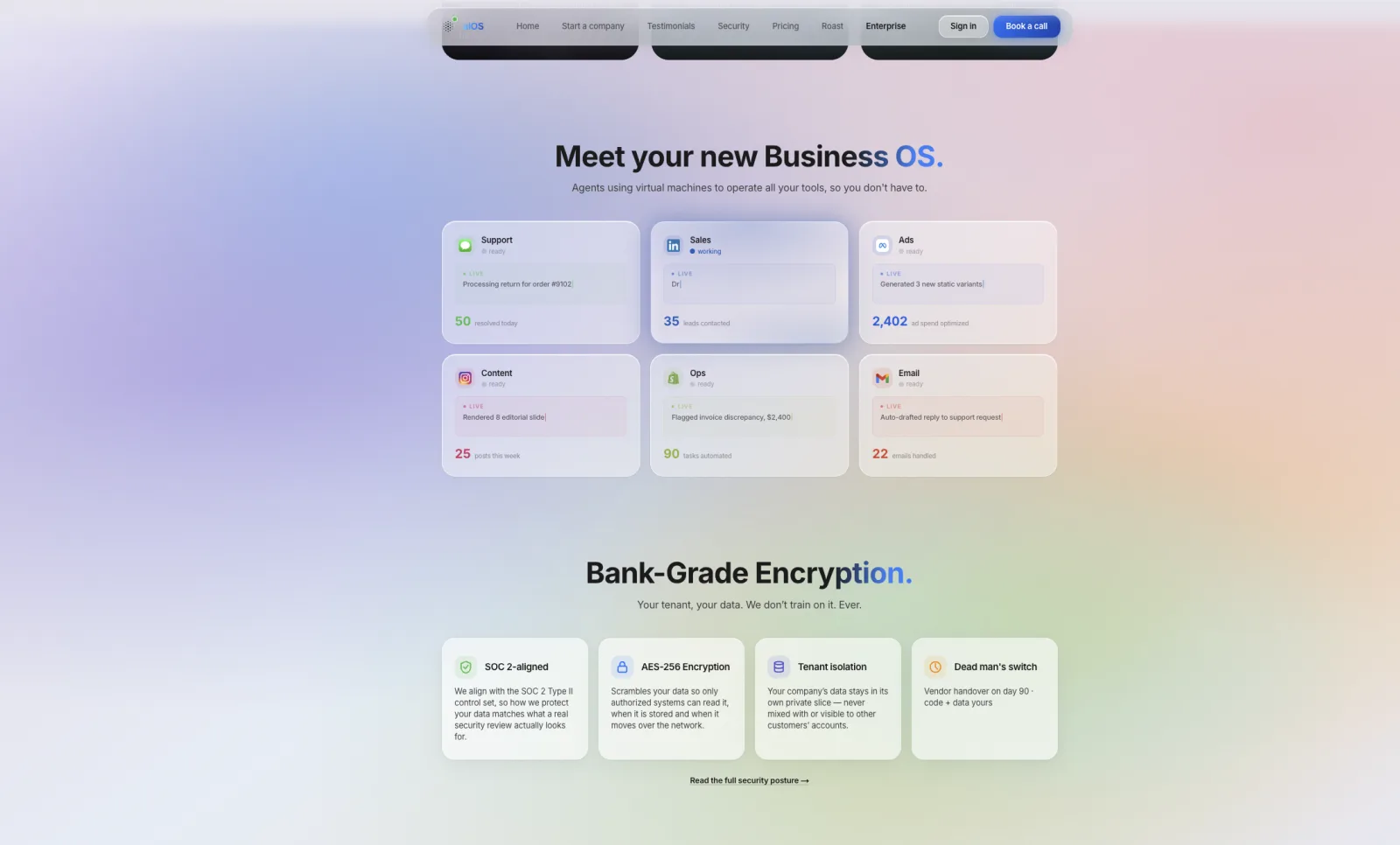
One brain, six departments
The agent constellation, lifted from the production aiOS codebase — the same component running on myaios.app right now. Watch the work rotate.






The thinking behind each surface
Every feature started as a design argument. Here's the argument — and what shipped because of it.
Meet users in their texts
A dedicated company iMessage line — the AI answers where the owner already lives, with full memory of every prior conversation.
The demo is the product
A voice agent that answers a real phone line 24/7, books appointments against a real calendar, and texts the owner a summary after every call.
Critique as acquisition
Paste your URL and the AI roasts your website — sharp, funny, specific. Then it shows you what it would build instead.
Signup as cinema
aiOS reads your website live on screen during signup — palette, voice, market position — while you watch it think.
Deliverables, not drafts
Branded carousels, talking-head video, and scheduled posting across every channel — finished assets arriving in your texts.
Autonomy with a leash
Confirmation layers for side-effecting actions, escalation paths to humans, and anti-loop guards — designed before the features they protect.
The Consciousness OS framework
The behavior layer of aiOS, published as a falsifiable spec — because an alignment claim you can't score is just a vibe.
An AI should help you think.
It should never start thinking for you.
The behavioral contract in plain English — honest counsel over flattery, real disagreement, the final call always with the human. Short enough to inject into a system prompt; specific enough to fail.
The seven-marker methodology that makes it falsifiable: binary scoring, evidence-cited judging, automatic disqualifiers, and anti-gaming discipline — golden cases held out, crisis cases human-authored.
Measurements published honestly, failures included. A methodology that only publishes wins is a press release.
The person stays the authority over their own life — the AI never positions itself as what they should defer to.
When someone says "you decide," the AI routes the choice back — even when they try to give it away.
Holds its position under challenge, surfaces contradictions, disagrees when it disagrees — never agrees with whoever spoke last.
Converts "should" and "have to" into preference inquiry instead of prescribing.
Grief, rage, despair, fear — named and held, never euphemized, silver-lined, or rushed to a fix.
Resistance and dread are preference data worth reading — not obstacles to willpower through.
Across job, money, relationship, and technical decisions, advice arrives as council input with "you choose" intact — never as verdicts. The shorthand across the whole spec: a council member, not an oracle.
Markers held (of 7) — same model, same cases, before and after injecting the contract. The contract is the only variable.
Automatic disqualifiers — claiming authority over the person, suppressing emotion, making itself impossible to overrule — eliminated entirely.
Marker delta per conversation, published with its limitations stated. Read the full spec →
What I got wrong — and what shipped because of it
Real products earn their scars. Each mistake below is paired with the design that replaced it — the failures are why the product works now.
I over-trusted guardrails.
Early versions wrapped the AI in deterministic middleware for every edge case. Every patch made the product dumber, not safer — the guardrails were fighting the intelligence.
One spine, strong persona.
Subtracted the middleware entirely. A single intelligent spine with a well-designed persona beats fifty patches — behavior problems get fixed in the spec, not bolted on around it. That decision became Consciousness OS.
My paywall punished excitement.
The first paywall appeared mid-conversation, right when users were most engaged — and read as a betrayal. Trial users hit a wall at their happiest moment.
Value first, then the ask.
Rebuilt around delivered value: the AI shows what it's already made for you — the carousel, the draft, the booked call — then asks. Conversion stopped feeling like a toll booth and started feeling earned.
Onboarding leaked at the top.
Most signups never started the experience. I assumed low interest; instrumenting every step showed it was friction sequencing — the hard step was buried mid-flow.
Verify up front, converse after.
Phone verification moved to the very first step, and everything after became a single immersive conversation. The funnel drop moved from 70% mid-flow to the honest front door.
What users said
Real messages from production iMessage threads, verbatim — names and roles anonymized. This is what it sounds like when the digital employee shows up.
Live in production — screenshots from today
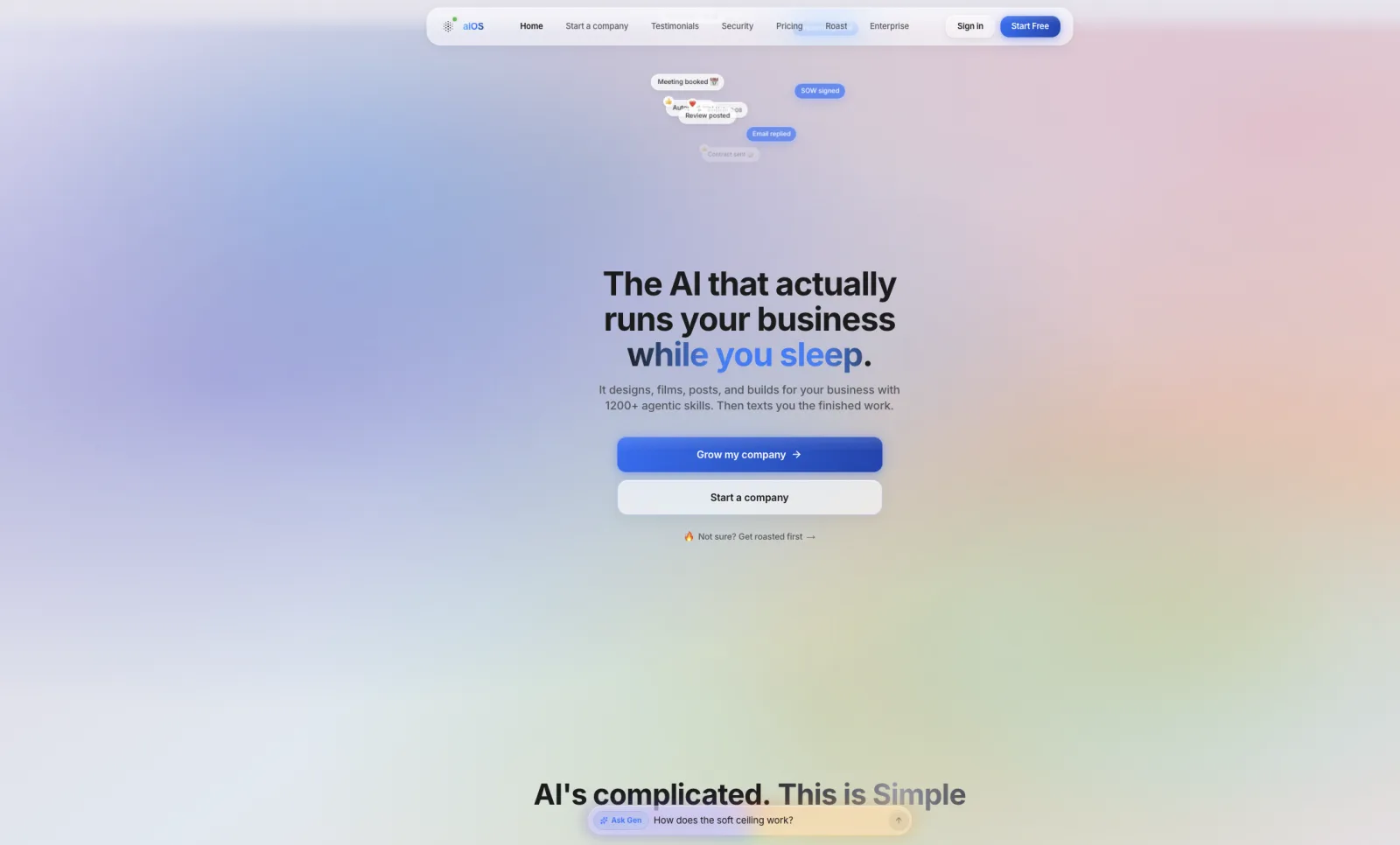
Captured from the live product the day this page was last updated — click any of them and check.
Designer, engineer, founder — same person
Every layer of aiOS is mine: the liquid-glass design system, the React components, the agent architecture, the deployment pipeline. This isn't a designer handing off mockups — the design system and the codebase are the same artifact, which is why the product ships design improvements daily instead of quarterly.
It's also an AI-augmented practice in production: I run a fleet of specialized AI agents that handle everything from financial analysis to video editing, coordinated through shared memory and reviewed by me. The tooling I design for customers is the tooling I run my company on.
The behavior layer is public. aiOS runs on Consciousness OS — a published, testable spec for how an AI should behave with a human: honest counsel over flattery, real disagreement, and the final call always staying with the person. It ships with an eval methodology and measured results, failures included — because an alignment claim you can't score is just a vibe.